SASSA Foster Child Grant 2026

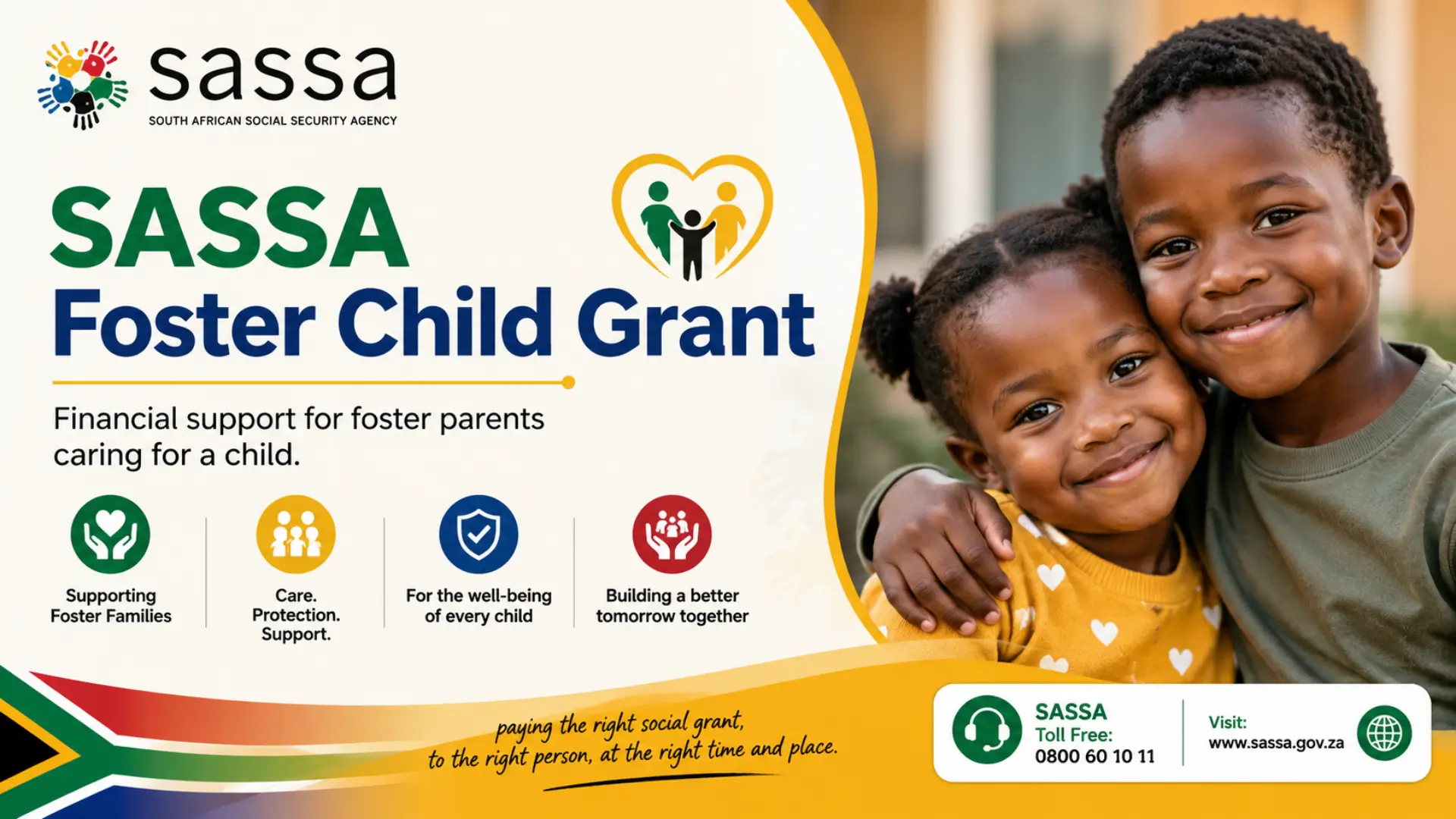
Raising a foster child comes with real financial responsibilities. The SASSA Foster Child Grant 2026 is designed to help you cover those costs every single month. If you are a court-appointed foster parent in South Africa, this grant gives you direct monthly financial support to care for the child placed in your home.
This guide covers everything you need to know: who qualifies, how much you receive, how to apply, the court order requirement, payment dates, and how to check your status. Read on for a complete, updated breakdown.
What is the SASSA Foster Child Grant?
The SASSA Foster Child Grant is a monthly social assistance payment managed by the South African Social Security Agency (SASSA). It is paid to caregivers who are legally appointed by a Children’s Court to look after a child who cannot live with their biological parents.
The grant exists to ensure children in foster care have access to food, clothing, healthcare, and education. It also recognises that foster parents take on significant financial responsibility often for children who have been orphaned, abandoned, abused, or neglected.
Foster Child Grant vs Child Support Grant
These two grants are often confused. Here is the key difference:
| Feature | Foster Child Grant | Child Support Grant |
|---|---|---|
| Who receives it | Court-appointed foster parent | Primary caregiver (biological or not) |
| Court order required | Yes | No |
| Amount (2026) | R1 290/month | R580/month |
| Means test | No | Yes |
The foster care grant South Africa pays more than the Child Support Grant because foster parents take on full legal responsibility for the child. Additionally, there is no income or asset means test for the Foster Child Grant your income level does not affect your eligibility.
SASSA Foster Child Grant 2026 Payment Amount
How much is the Foster Child Grant in 2026? From April 2026, the grant pays R1 290 per child per month.
This is an increase of R40 from the previous amount of R1 250. The increase was announced by the Minister of Finance during the 2026 Budget Speech and took effect from 1 April 2026. Each foster child in your care qualifies for a separate grant so if you care for two foster children, you receive R2 580 per month.
How Payments Are Made
SASSA pays the grant directly into your chosen payment method:
- Bank account: deposited directly on your payment date
- SASSA Gold Card / Postbank account: collect from ATMs, retailers, or Post Office branches
- Cash pay points: available in areas where banking access is limited
Payments remain in your account until you collect them. You do not have to withdraw on the exact payment date.
What Affects Your Payment?
- Your court order must be valid and current at all times
- Your banking details must be correct and up to date with SASSA
- Any change in the child’s circumstances (such as returning to biological parents) will affect payment
- Annual SASSA reviews can also temporarily affect payments if you do not respond
Who Qualifies for the Foster Child Grant?
The Foster Child Grant requirements are clear and non-negotiable. You must meet all of the following criteria:
Foster Parent Requirements
- You must be a South African citizen, permanent resident, or recognised refugee
- You must live in South Africa
- You must be legally appointed by a Children’s Court as the child’s foster parent
- You must be the person actually caring for the child in your home
Child Requirements
- The child must be under 18 years old
- The grant can be extended to age 21 if the child is still attending school (a school attendance certificate must be submitted)
- The child must be legally placed in your care through a valid court order
- The child must live with you in South Africa
Court Order for Foster Child Grant
This is the single most important requirement. A court order for the foster child grant must come from a Children’s Court. Without it, SASSA cannot approve your application.
Court orders for foster care typically expire every two years. You must contact your social worker before the expiry date to have the order extended. If your court order expires and is not renewed, SASSA will stop payments automatically.
Children who are typically placed through the court system include those who are:
- Orphaned
- Abandoned
- Abused or neglected
- In need of care and protection as determined by a court
How to Apply for Foster Child Grant?
Applying for the Foster Child Grant is a straightforward process but you must have your court order in place first. Here is a step-by-step guide:
Step 1: Obtain a valid court order
Your social worker assists with this process. The order must be issued by a Children’s Court and must confirm your legal status as a foster parent.
Step 2: Gather your required documents
Make sure everything is in order before your SASSA appointment.
Step 3: Visit your nearest SASSA office
Walk in during office hours. No online application is available for this grant you must apply in person.
Step 4: Complete the application form
A SASSA official will help you complete the correct form. They will verify your court order and documents.
Step 5: Submit your supporting documents
Hand over all your original documents. SASSA may make copies.
Step 6: Receive proof of application
SASSA will give you a reference number and receipt. Keep this safe you will need it for your SASSA Foster Child Grant status check.
Required Documents
Bring the following to your appointment:
- Your South African ID (original)
- The child’s birth certificate
- Valid foster care court order (original)
- Proof of marital status (marriage certificate, or death certificate of spouse if widowed)
- Certified bank statement (not older than 3 months)
- Proof of address
- Refugee documentation (if applicable)
Tip: Bring certified copies of all documents as well as the originals. SASSA may require both. If your application is rejected, you can submit a SASSA Appeal to have the decision reviewed.
SASSA Foster Child Grant Payment Dates 2026
SASSA Foster Child Grant payment dates 2026 follow a set monthly schedule approved by National Treasury. The Foster Child Grant falls under the children’s grants category, which is always paid on the third business day of each monthly payment cycle after older persons and disability grants.
Official 2026 Payment Schedule
| Month | Children’s Grant Payment Date |
|---|---|
| April 2026 | 8 April 2026 |
| May 2026 | 7 May 2026 |
| June 2026 | 4 June 2026 |
| July 2026 | To be confirmed |
| August 2026 | To be confirmed |
| September 2026 | To be confirmed |
| October 2026 | To be confirmed |
| November 2026 | To be confirmed |
| December 2026 | To be confirmed |
Always verify your exact date on the official SASSA Payment Schedule or by calling 0800 60 10 11 (toll-free).
Payment Reminders
- SASSA does not pay on Mondays, the 1st of the month, or public holidays
- If a scheduled date falls on a weekend or holiday, payment shifts to the next working day
- Your money stays in your account collect it at your convenience after the payment date
- If payment is delayed, visit your nearest SASSA office immediately with your ID and proof of application
How to Perform a SASSA Foster Child Grant Status Check
Once you have applied, you want to know where your application stands. Here is how to do a SASSA Foster Child Grant status check:
Online Status Check
- Go to the official SASSA website: www.sassa.gov.za
- Click on “Check Your Status”
- Enter your South African ID number
- Enter your phone number linked to your application
- View your current status
SASSA WhatsApp Status Check
- Save 082 046 8553 to your contacts
- Send “Hello” to start the session
- Follow the prompts to check your grant status
Common Status Messages Explained
| Status Message | What It Means |
|---|---|
| Pending | Your application is being processed |
| Approved | Your grant has been approved await payment date |
| Active | You are receiving payments |
| Declined | Your application was not approved |
| Lapsed | Your court order has expired |
What to Do If Your Application Is Declined
- Request a written reason for the rejection from SASSA
- You have the right to appeal within 90 days
- Submit your appeal to the Minister of Social Development through your nearest SASSA office
- Bring all supporting documents, including your court order
Foster Child Grant Reviews and Renewals
SASSA conducts annual reviews to confirm that you still qualify for the grant. This is standard practice and does not mean your grant is being cancelled.
What Triggers a Review?
- Your court order is approaching expiry
- SASSA needs to verify the child is still in your care
- A scheduled annual eligibility review
How to Renew Your Grant
- Contact your social worker well before your court order expires
- Apply to the Children’s Court for an extension of the foster care order
- Take the renewed court order to your nearest SASSA office
- SASSA will update your record and continue payments
Circumstances That May Suspend Payments
- Court order expires without renewal
- Child returns to biological parents
- Child turns 18 and is no longer in school
- You fail to respond to a SASSA review notice
- Incorrect banking details on file
Always respond to SASSA review notices promptly. Ignoring them is one of the fastest ways to have your payments suspended.
Common Reasons Foster Child Grant Applications Are Rejected
Understanding why applications fail can save you time and frustration. The most frequent rejection reasons are:
- Missing or invalid court order: The most common reason. Your court order must be current and issued by a Children’s Court.
- Incomplete documentation: Missing birth certificate, ID, or proof of address.
- Incorrect personal information: Name spelling or ID number errors cause verification failures.
- Residency issues: You or the child is not currently living in South Africa.
- Child is over 18: And no school attendance certificate has been submitted.
- Court order belongs to someone else: The person named in the court order must be the person applying.
Fixing these issues is straightforward in most cases. Visit your nearest SASSA office with the correct documents and reapply.
Tips for Foster Parents Receiving SASSA Grants
As a foster parent grant SASSA recipient, staying organised protects your payments. These practical tips will help you avoid unnecessary interruptions:
- Keep your court order updated: Set a reminder 3 months before expiry. Contact your social worker early.
- Update your ID details: If your name or ID number changes, update SASSA immediately.
- Keep banking details current: Notify SASSA as soon as you change banks or accounts.
- Respond to SASSA notices: If you receive a review notice, act quickly. Delays cost you payments.
- Keep copies of all documents: Store certified copies of your court order, ID, and child’s birth certificate in a safe place.
- Submit school certificates on time: If your foster child turns 18 and is still in school, submit their attendance certificate before payments lapse.
- Update your address: If you move, inform SASSA. Your physical location matters for eligibility verification.
Frequently Asked Questions
Conclusion
The SASSA Foster Child Grant 2026 is a vital source of financial support for foster parents across South Africa. From April 2026, the grant pays R1 290 per child per month with no income means test standing between you and your approved payment.
To qualify, you need a valid Children’s Court order, meet the residency requirements, and ensure the child is in your active care. Applying is straightforward: gather your documents, visit your nearest SASSA office, and submit your court order. Once approved, use the SASSA online portal or WhatsApp to track your status and confirm your payment dates each month.
Related Post
- SASSA Child Support Grant 2026
- SASSA Old Age Grant 2026
- SASSA Disability Grant 2026
- SASSA Care Dependency Grant 2026
- SASSA Grant in Aid 2026
- SASSA War Veterans Grant 2026